
Steelhead, Searuns, and Western River Outlooks
Fly of the Week
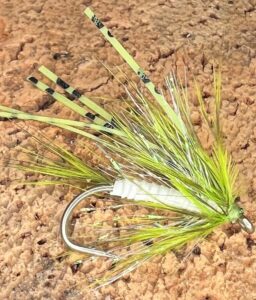
Bob Gert
Hook: Ahrex AFW 580, #8
Thread: Chartreuse 8/0 Uni-Thread
Tail: Chartreuse or Yellow Grizzly Saddle hub N Hackle
Body: White Atomic Glow 1/16” strip
Under Hackle: Pearl Cactus Hackle
Legs: Chartreuse/black barred Sili Legs
Collar Hackle: Chartreuse or Yellow Grizzly Saddle Hackle
For the past thirty years or more, the Joe Gert has been a favorite of Deschutes summer steelhead pros. Once a “secret fly,” the purple-bodied, pink rubber-legged wet fly has worked its way into “standard” status for most western steelheaders by the early aughts. I loved tying up hundreds each summer for NWFFO back in the 1990s and still remember warm summer mornings prepping piles of chenille, round rubber, tinsel, and purple schlappen OEG a fly that I would almost certainly never fish IRL.
Like most patterns, I would always keep a couple of the ugliest Joe Gerts for myself. However, they rarely found purchase with the fish I regularly chased. Trout were too aloof for such an awkward offering, and despite its tantalizing legs, the pink/purple color scheme never seemed to fool many smallies or panfish.
However, the style always haunted my imagination…it just seemed like something that should fool a broader range of species than it did.
About 15 years ago, a fellow tyer, Al Wood, handed me a package of his Atomic Glow at a tying show to play around with. This then-brand-new rubbery tying material came in both sheets and 1/16” strips. One side appears like plain rubber, the other is slightly shiny, and when exposed to sunlight or a flashlight, it glows in the dark for a durable amount of time. I was impressed with the possibilities—some materials market themselves in uv as UV or “glow in the dark,” but this stuff is absolutely It for radiant after a shot with a UV flashlight.
The problem was what to do with it. The pliability and thickness of the fly make it great for larger bass, steelhead, and saltwater patterns. But the strips are a bit wide and stiff to use as legs on smaller flies without some trimming, and the bold iridescence of Atomic Glow works best when deployed on attractor patterns. While I used small pieces as a “sighter” on caddis, beetle, and hopper patterns fished in low lights, my favorite use was as a body wrapping material.
The “Bob Gert” was an attempt to replace the silver tinsel and purple chenille body with white Atomic Glow. Wrapping the strips with the iridescent side facing out creates a banding effect, while the Cactus Hackle and saddle hackle collar break up the intense radiance of the body. The barred rubber legs create further distraction and mottling to temper the luminous body.
After a couple of experiments with color variations, the warmwater standard chartreuse-and-white or yellow-and-white proved to be the winner. The curiosity of panfish and bass for yellow shades cannot be overstated—sometimes I throw an oversized Yellow Woolly Bugger on a new warmwater lake just to see what might follow and adapt my approach accordingly.
This past week, the fly did its job up at Quebec’s Lac Ouimet, where I tossed it near the rocky banks for spunky rock bass and smallmouth and trolled the milfoil edges for perch I could only dream of back home in Oregon. Busy with navigating the canoe for casters in the bow, I was too busy to change flies, but the universal success of the pattern obviated that need.
Jeff Morgan
Author, Tyer, and all-around Fly Geek

